
Website & SEO
SEO basics for your first business website
Focus your pages on real customer questions, write clear search titles and check the technical basics before chasing a score.
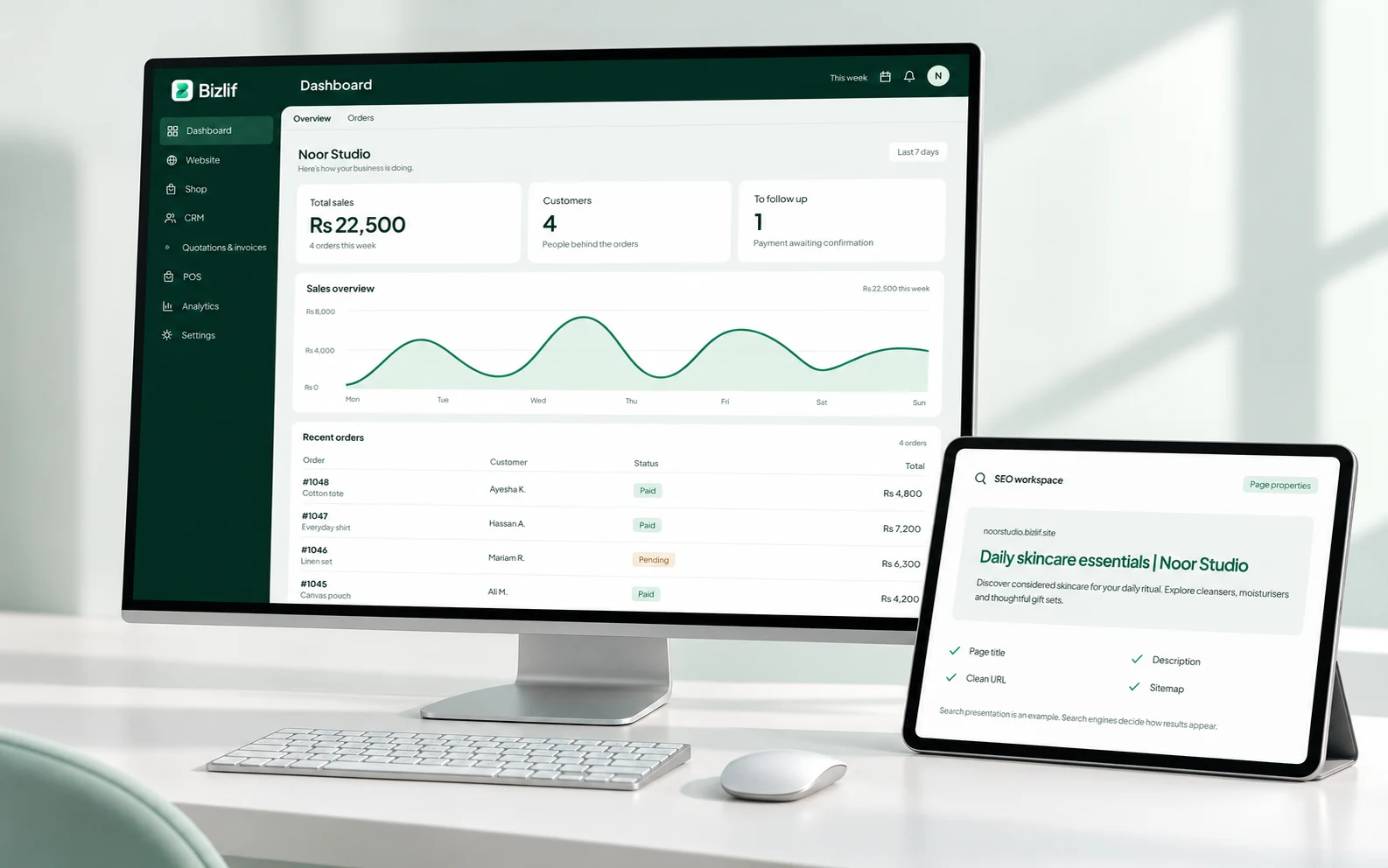
Search engine optimisation starts with a useful, accessible website. Before worrying about a score, make sure a visitor can understand your offer, use your pages and find accurate information about your business.
No page title, plugin or checklist can guarantee a first-place ranking. Search results depend on many factors, including the query, competition and the quality of the answer your page provides.
Give each page one clear job
A service page should help someone decide whether to request that service. A product page should explain the actual product. A contact page should make it easy to reach the right business. Avoid making every page a slightly different version of the same sales paragraph.
Use the words customers use, but include places, services and product claims only when they are accurate. A business serving Lahore should explain its real coverage rather than listing every city in Pakistan to attract unrelated searches.
Write a descriptive title and introduction
The search title should describe the specific page and distinguish it from other pages on your website. “Custom bakery cakes in Lahore | Your Business” is clearer than “Home” when it accurately describes the offer. The page heading and introductory text should support the same topic.
Use the meta description to summarise what a visitor will find. Write for someone choosing a useful result, not for a keyword counter. Search engines may choose a different title or snippet, so do not rely on a preview being reproduced word for word.
Answer the questions before the customer asks
Explain details that affect a buying decision: dimensions, materials, service coverage, availability, delivery arrangements or how a quotation is prepared. Use your own knowledge and photos where possible.
A practical FAQ can help when it answers questions specific to the product or service. Repeating broad questions on every page adds clutter. Remove unsupported superlatives, invented reviews and claims you cannot verify.
Check links, mobile layout and indexing
Open your website on a phone and follow the links as a customer would. Fix missing pages, unreadable layouts and buttons that lead nowhere. Describe meaningful images with useful alternative text, and avoid putting important information only inside an image.
Review readable URLs, canonical settings, indexing choices and the XML sitemap. A noindex setting is useful for a page you do not want in search, but it will prevent that page from being eligible for normal indexing. Password protection and access control are separate requirements for private information.
If an established URL changes, review redirects so shared links still lead to the right place. In Bizlif, use the website SEO settings alongside the content you are publishing.
Measure and improve after publishing
Connect supported Google Search Console and Analytics integrations when you are ready to measure results. Check which searches and pages bring relevant visitors, then improve weak pages with clearer answers and better navigation.
Read Google’s guidance on helpful, reliable content for a first-party explanation of the approach. Treat SEO as ongoing work for your customers rather than a one-time score to maximise.
Build useful internal links
An internal link should help the visitor continue a task. Link a store category to its products, a product to delivery information and a service page to a relevant case example. Use a label that explains the destination instead of repeating “click here”.
For example, someone reading about making a website without code may need the launch checklist next. Someone choosing between platforms may need a comparison of the available workflows. Those links have a reason to exist beyond adding keywords.
Use outside sources where they improve the answer
When explaining a rule from Google or a feature belonging to another provider, link to its official documentation. Check the information again when it changes. A citation is evidence for a claim; it is not a guarantee that search engines will rank the page.
Google’s SEO Starter Guide covers the basics of crawlable pages, useful content and links. Its spam policies explain practices to avoid, including keyword stuffing and publishing near-duplicate doorway pages.